Google AdSense is a program run by Google that allows publishers in the Google Network of content sites to serve automatic text, image, video, or interactive media advertisements, that are targeted to site content and audience. These advertisements are administered, sorted, and maintained by Google, and they can generate revenue on either a per-click or per-impression basis. Google beta-tested a cost-per-action service, but discontinued it in October 2008 in favor of a DoubleClick offering (also owned by Google).[2] In Q1 2014, Google earned US $3.4 billion ($13.6 billion annualized), or 22% of total revenue, through Google AdSense.[3]
Google uses its Internet search technology to serve advertisements based on website content, the user's geographical location, and other factors. Those wanting to advertise with Google's targeted advertisement system may enroll through Google AdWords. AdSense has become one of the popular programs that specializes in creating and placing banner advertisements on a website, because the advertisements are less intrusive and the content of the advertisements is often relevant to the website.
Many websites use AdSense to monetize their content; it is the most popular advertising network.[4] AdSense has been particularly important for delivering advertising revenue to small websites that do not have the resources for developing advertising sales programs and sales people to generate revenue with. To display contextually relevant advertisements on a website, webmasters place a brief Javascript code on the websites' pages. Websites that are content-rich have been very successful with this advertising program, as noted in a number of publisher case studies on the AdSense website. AdSense publishers may only place up to three link units on a page, in addition to the three standard ad units, and two search boxes.[5] This restriction is not applicable for premium publishers who work directly with account managers at Google.
Some webmasters put significant effort into maximizing their own AdSense income. They do this in three ways:[citation needed]
- They use a wide range of traffic-generating techniques, including but not limited to online advertising.
- They build valuable content on their websites that attracts AdSense advertisements, which pay out the most when they are clicked.
- They use text content on their websites that encourages visitors to click on advertisements. Note that Google prohibits webmasters from using phrases like "Click on my AdSense ads" to increase click rates. The phrases accepted are "Sponsored Links" and "Advertisements".
The source of all AdSense income is the AdWords program, which in turn has a complex pricing model based on a Vickreysecond price auction. AdSense commands an advertiser to submit a sealed bid (i.e., a bid not observable by competitors). Additionally, for any given click received, advertisers only pay one bid increment above the second-highest bid. Google currently shares 68% of revenue generated by AdSense with content network partners, and 51% of revenue generated by AdSense with AdSense for Search partners.[6]
History[edit]
Google launched its AdSense program, originally named content targeting advertising in March 2003.[7] The AdSense name was originally used by Applied Semantics, a competitive offering to AdSense and then adopted by Google after Google acquired Applied Semantics in April 2003.[8] Applied Semantics was started in 1998 by Gilad Elbaz and Adam Weissman. Some advertisers complained that AdSense yielded worse results than AdWords, since it served ads that related contextually to the content on a web page and that content was less likely to be related to a user's commercial desires than search results. For example, someone browsing a blog dedicated to flowers was less likely to be interested in ordering flowers than someone searching for terms related to flowers. As a result, in 2004 Google allowed its advertisers to opt out of the AdSense network.[9]
Paul Buchheit, the founder of Gmail, had the idea to run ads within Google's e-mail service. But he and others say it wasSusan Wojcicki, with the backing of Sergey Brin, who organized the team that adapted that idea into an enormously successful product.[10] By early 2005 AdSense accounted for an estimated 15 percent of Google's total revenues.[9]
In 2009, Google AdSense announced that it would now be offering new features, including the ability to "enable multiple networks to display ads".
In February 2010, Google AdSense started using search history in contextual matching to offer more relevant ads.[11]
On January 21, 2014, Google AdSense launched Direct Campaigns, a tool where publishers may directly sell ads.
Types[edit]
AdSense for Content[edit]
The content-based adverts can be targeted for interest or context. The targeting can be CPC (click) or CPM (impression) based. There's no significant difference between CPC and CPM earnings, however CPC ads are more common. There are various ad sizes available for content ads. The ads can be simple text, image, animated image, flash, video, or rich media ads. At most ad sizes, users can change whether to show both text and multimedia ads or just one of them. As of November 2012, a grey arrow appears beneath AdSense text ads for easier identification.
AdSense for Feeds[edit]
In May 2005, Google announced a limited-participation beta version of AdSense for Feeds, a version of AdSense that runs on RSS and Atom feeds that have more than 100 active subscribers. According to the Official Google Blog, "advertisers have their ads placed in the most appropriate feed articles; publishers are paid for their original content; readers see relevant advertising—and in the long run, more quality feeds to choose from."[12]
AdSense for Feeds works by inserting images into a feed. When the image is displayed by a RSS reader or Web browser, Google writes the advertising content into the image that it returns. The advertisement content is chosen based on the content of the feed surrounding the image. When the user clicks the image, he or she is redirected to the advertiser's website in the same way as regular AdSense advertisements.
AdSense for Feeds remained in its beta state until August 15, 2008, when it became available to all AdSense users. On December 3, 2012, Google discontinued AdSense For Feeds program.[13]
AdSense for Search[edit]
AdSense for search allows enables publisher to display ads relating to search terms on their site and receive 51% of the revenue generated from those ads.[6] AdSense custom search ads can be displayed either alongside the results from an AdSense Custom Search Engine or alongside internal search results through the use of Custom Search Ads. Custom Search Ads are only available to white-listed publishers.
Although the revenue share from AdSense for Search (51%) is lower than from AdSense for Content (68%) higher returns can be achieved due to the potential for higher Click Through Rates.
AdSense for mobile content[edit]
AdSense for mobile content allowed publishers to generate earnings from their mobile websites using targeted Google advertisements. Just like AdSense for content, Google matches advertisements to the content of a website — in this case, a mobile website. Instead of traditional JavaScript code, technologies such as Java and Objective-C are used. As of February 2012, AdSense for Mobile Content was rolled into the core AdSense for Content offering to better reflect the lessening separation between desktop and mobile content.[14]
AdSense for domains[edit]
AdSense for domains allows advertisements to be placed on domain names that have not been developed. This offers domain name owners a way to monetize domain names that are otherwise dormant or not in use. AdSense for domains is currently being offered to all AdSense publishers, but it wasn't always available to all.
On December 12, 2008, TechCrunch reported that AdSense for Domains is available for all US publishers.[15]
On February 22, 2012, Google announced that it was shutting down its Hosted AdSense for Domains program.[16]
AdSense for video[edit]
AdSense for video allows publishers with video content to generate revenue using ad placements from Google's extensiveadvertising network including popular YouTube videos.[17]
How AdSense works[edit]
- The webmaster inserts the AdSense JavaScript code into a webpage.
- Each time this page is visited, the JavaScript code uses inlined JSON to display content fetched from Google's servers.
- For contextual advertisements, Google's servers use a cache of the page to determine a set of high-value keywords. If keywords have been cached already, advertisements are served for those keywords based on the AdWords bidding system. (More details are described in the AdSense patent.)
- For site-targeted advertisements, the advertiser chooses the page(s) on which to display advertisements, and pays based on cost per mille (CPM), or the price advertisers choose to pay for every thousand advertisements displayed.[18][19]
- For referrals, Google adds money to the advertiser's account when visitors either download the referred software or subscribe to the referred service.[20] The referral program was retired in August 2008.[21]
- Search advertisements are added to the list of results after the visitor performs a search.
- Because the JavaScript is sent to the Web browser when the page is requested, it is possible for other website owners to copy the JavaScript code into their own webpages. To protect against this type of fraud, AdSense customers can specify the pages on which advertisements should be shown. AdSense then ignores clicks from pages other than those specified.
Abuse[edit]
Some webmasters create websites tailored to lure searchers from Google and other engines onto their AdSense website to make money from clicks. Such websites often contain nothing but a large amount of interconnected, automated content (e.g., a directory with content from the Open Directory Project, or scraper websites relying on RSS feeds for content). Possibly the most popular form of such "AdSense farms" are splogs (spam blogs), which are centered around known high-paying keywords. Many of these websites use content from other websites, such as Wikipedia, to attract visitors. These and related approaches are considered to be search engine spam and can be reported to Google.[22]
A Made for AdSense (MFA) website or webpage has little or no content, but is filled with advertisements so that users have no choice but to click on advertisements. Such pages were tolerated in the past, but due to complaints, Google now disables such accounts.
There have also been reports of Trojan horses engineered to produce counterfeit Google advertisements that are formatted looking like legitimate ones. The Trojan uploads itself onto an unsuspecting user's computer through a webpage and then replaces the original advertisements with its own set of malicious advertisements.[23]



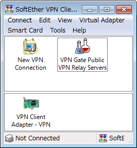 Simply install VPN Gate Client Plugin to SoftEther VPN Client. It will enable you to connect to any of our Public VPN Relay Servers of VPN Gate in a snap. It has a better throughput than L2TP, OpenVPN or SSTP. This program files are digitally signed by a certificate issued by GlobalSign. The binary file has a countersignature issued by Symantec.